

November 4 — 2026
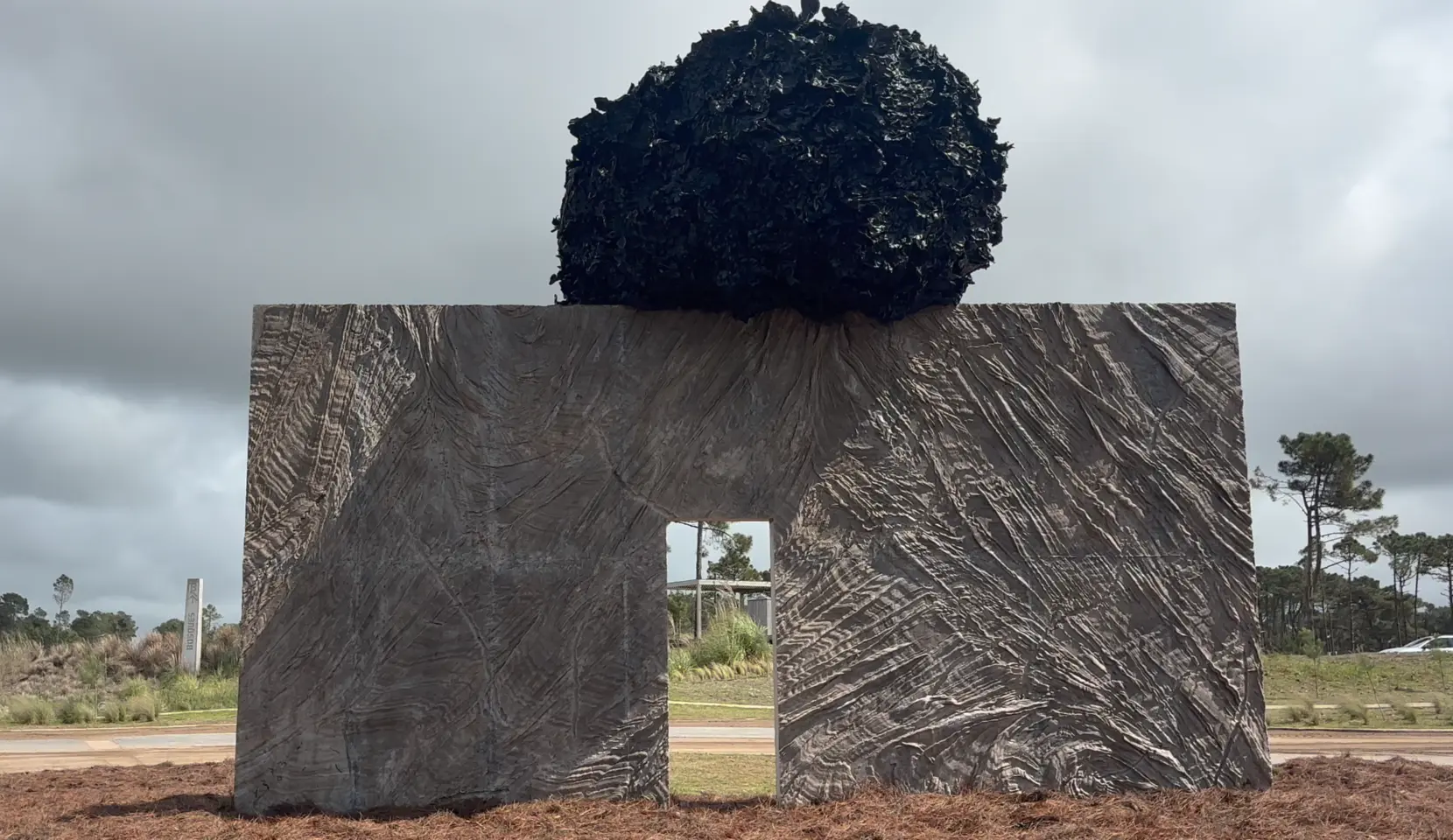
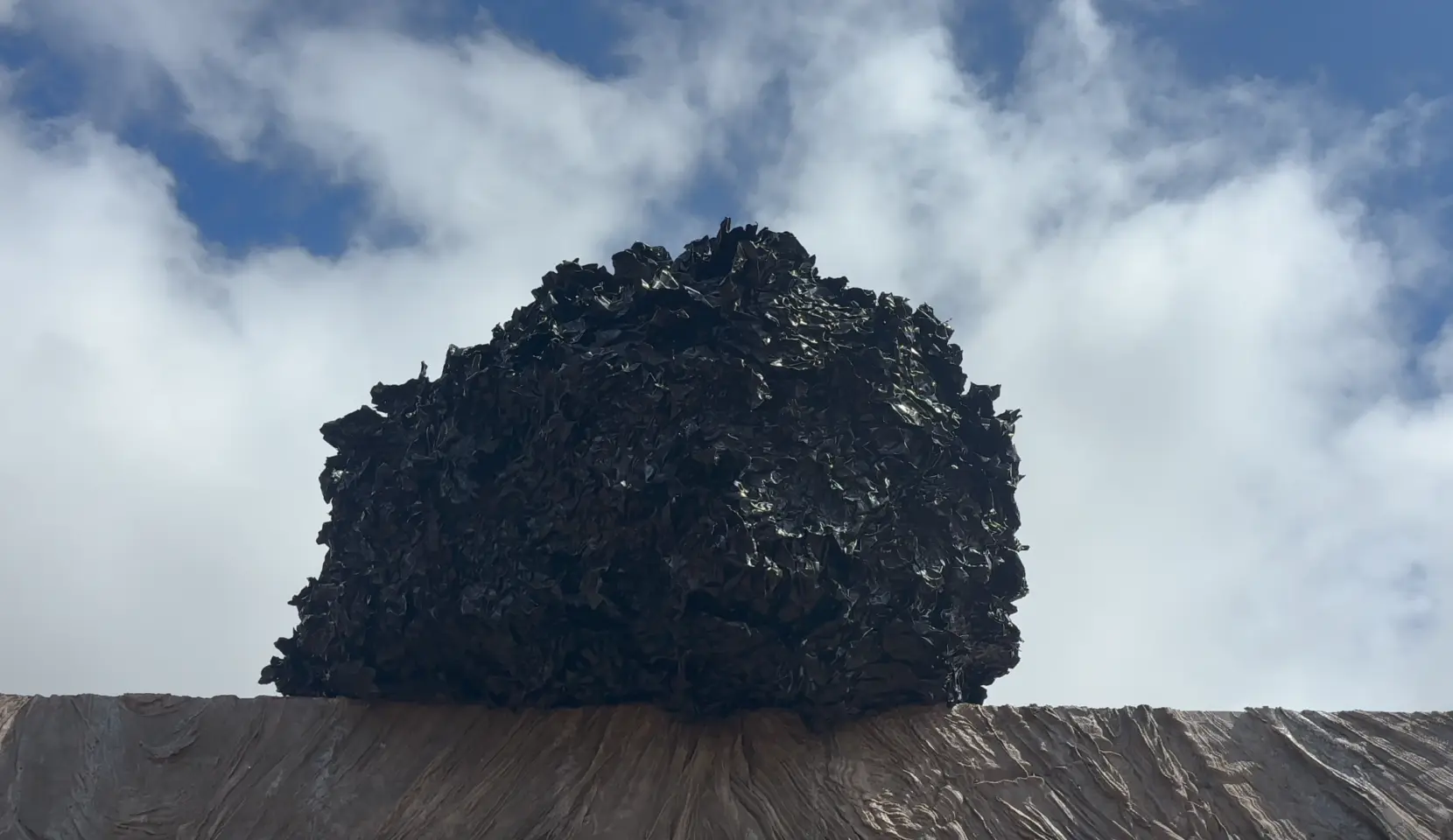
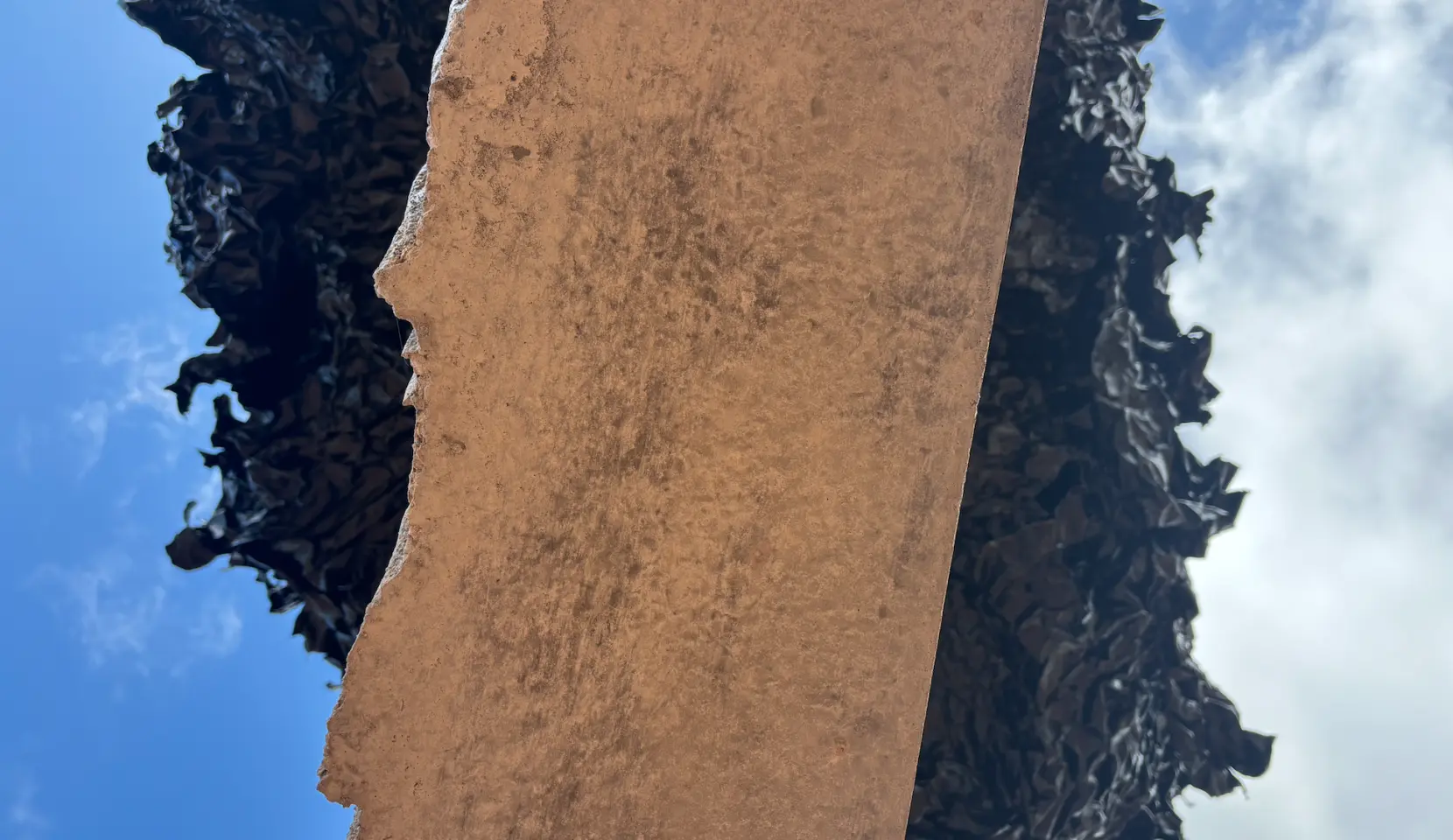
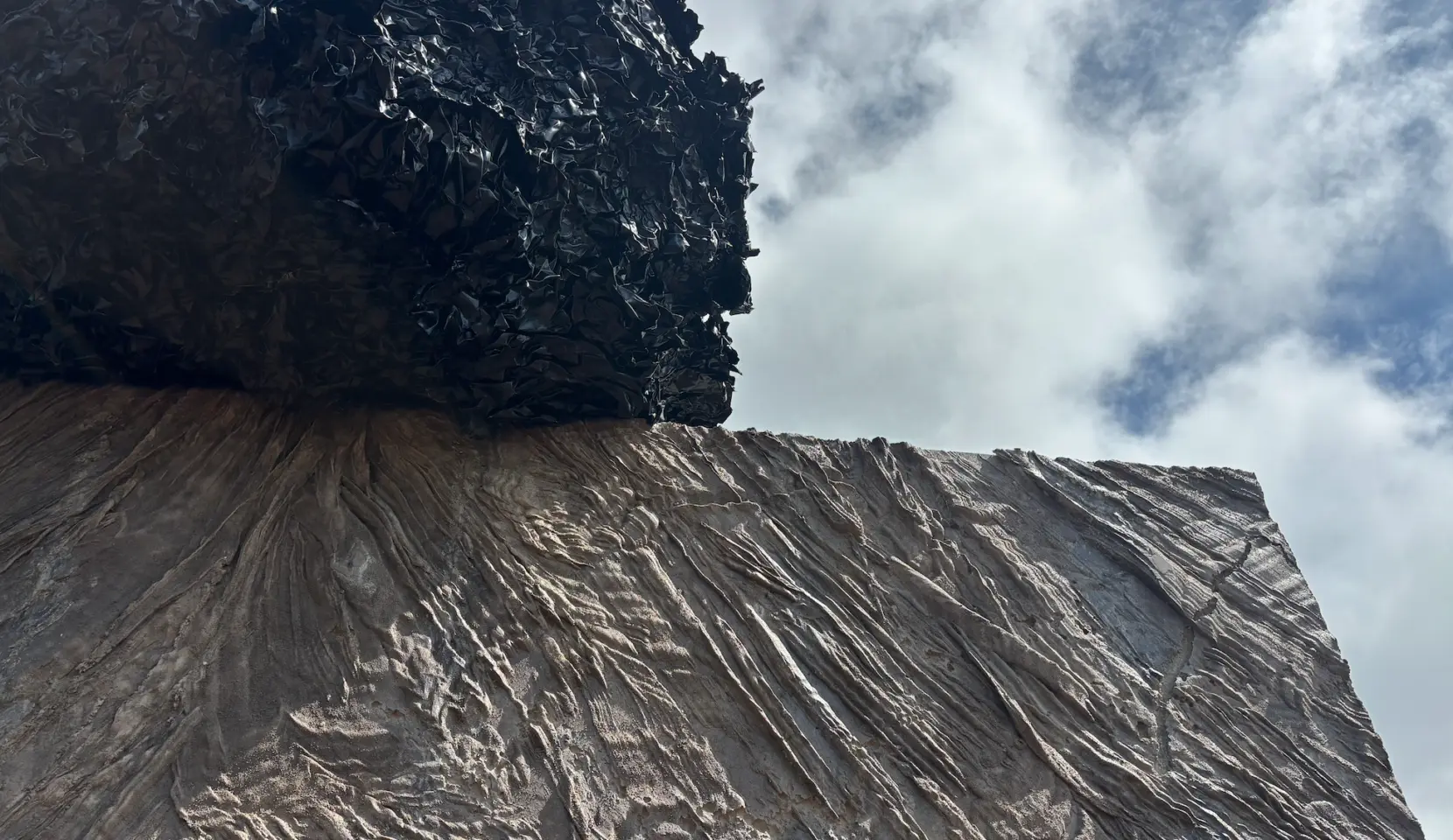
Cruz del Sur, 2026
A dark mass remains suspended above the path. Resembling a detached rock, it is held six meters above the ground by a structure whose slenderness makes the relationship between weight and support uncertain. Below, a wall with a single opening at its center defines a passageway. To cross Cruz del Sur, Eduardo Basualdo obliges us to move beneath something that seems on the verge of falling. Although engineering guarantees its stability, we perceive the imminence of a collapse.
This contradiction between knowledge and experience defines a persistent area of Basualdo’s practice. His sculptures and installations do not represent catastrophe; rather, they introduce a minimal yet decisive alteration in the order of things. A door ceases to separate two spaces; a railing both supports and obstructs; a wall loses its alignment; a heavy volume leaves the ground.
It is here that the uncanny emerges, not as the appearance of an unknown threat, but as a loss of familiarity within what is known. This experience unsettles the distinctions that organize reality: the intimate and the foreign, the interior and the exterior, the subject and the object cease to behave as separate terms. What should have remained hidden comes to light; what once seemed close acquires a disturbing strangeness. This estrangement does not come from outside. On the contrary, it reveals itself as embedded in the very structures that sustained our trust.
Cruz del Sur makes this inversion tangible. The stone, associated with gravity, permanence, and the ground, appears elevated above our heads. The wall, pierced at its center by a narrow opening, evokes one of the most archaic principles of architecture: the post-and-lintel system, capable of bringing together technique and symbol, delimiting a space and transforming it into a threshold and shelter. Its form thus refers to the transition through which humanity ceased merely to inhabit nature and began to deliberately transform it. In this installation, the wall does not protect us from danger: it channels the path toward it. Beneath the lintel, the only possible shelter from the imminent destabilization of the latent mass, we cease to see the artwork and begin to see the landscape. Above and below, shelter and exposure, stability and collapse are not entirely reversed, but they cease to be reliable. Basualdo does not destroy order: he holds it in tension in order to reveal its fragility.
The title also participates in this disturbance. The Southern Cross was, for centuries, a reference point for navigating journeys in the Southern Hemisphere. In a seaside city facing the ocean, it evokes voyages and searches for direction. However, the artwork no longer points toward a safe direction. Installed at a crossroads, it replaces the luminous constellation with an opaque silhouette that interrupts the sky. What should provide orientation instead produces disorientation and marks the point at which familiar coordinates enter into crisis.
This experience finds an echo in the present. In the face of the climate crisis, wars, and institutional weakening, certain technological elites are building shelters that would allow them to isolate themselves from the outside world, capable of generating energy and storing food. The paradox of these bunkers encapsulates an abject feature: the technology that promised to connect the world and ensure abundance becomes an instrument of separation; the home, a form of shelter, turns into a fortress; progress is no longer imagined as a collective endeavor, but as the possibility that a few might survive its consequences. The more self-sufficient these enclaves seek to become, the more clearly they expose the fragility of the order from which they seek to withdraw, as well as the dependencies that no wall can eliminate. Shelter becomes a threat.
Basualdo does not represent this world, nor does he turn the artwork into an illustration of a social diagnosis. His approach is more elemental: he alters the relationships between matter, body, and architecture until the precariousness of every support becomes perceptible. Unlike the bunker, which conceals danger behind its walls, Cruz del Sur raises it into the open space. It offers neither a protected interior nor a division between those who are saved and those left outside. Instead, it establishes a shared passage beneath a suspended mass.
There is a political dimension to this, one that does not arise from a slogan but from a shared experience. Situated in public space, the artwork interrupts everyday movements and transforms the urban crossing into a scene in which each passerby measures their relationship to weight, scale, and danger. Passing through requires moving across uncertainty.
Perhaps Cruz del Sur points not so much toward a direction as toward a condition of our time. We live within structures that remain standing, even as they no longer dispel the feeling of impending collapse. Basualdo makes this suspended moment visible: when the familiar loses its self-evidence and we understand that what sustains us could fall.
Eduardo Basualdo