

April 30 — June 6, 2026
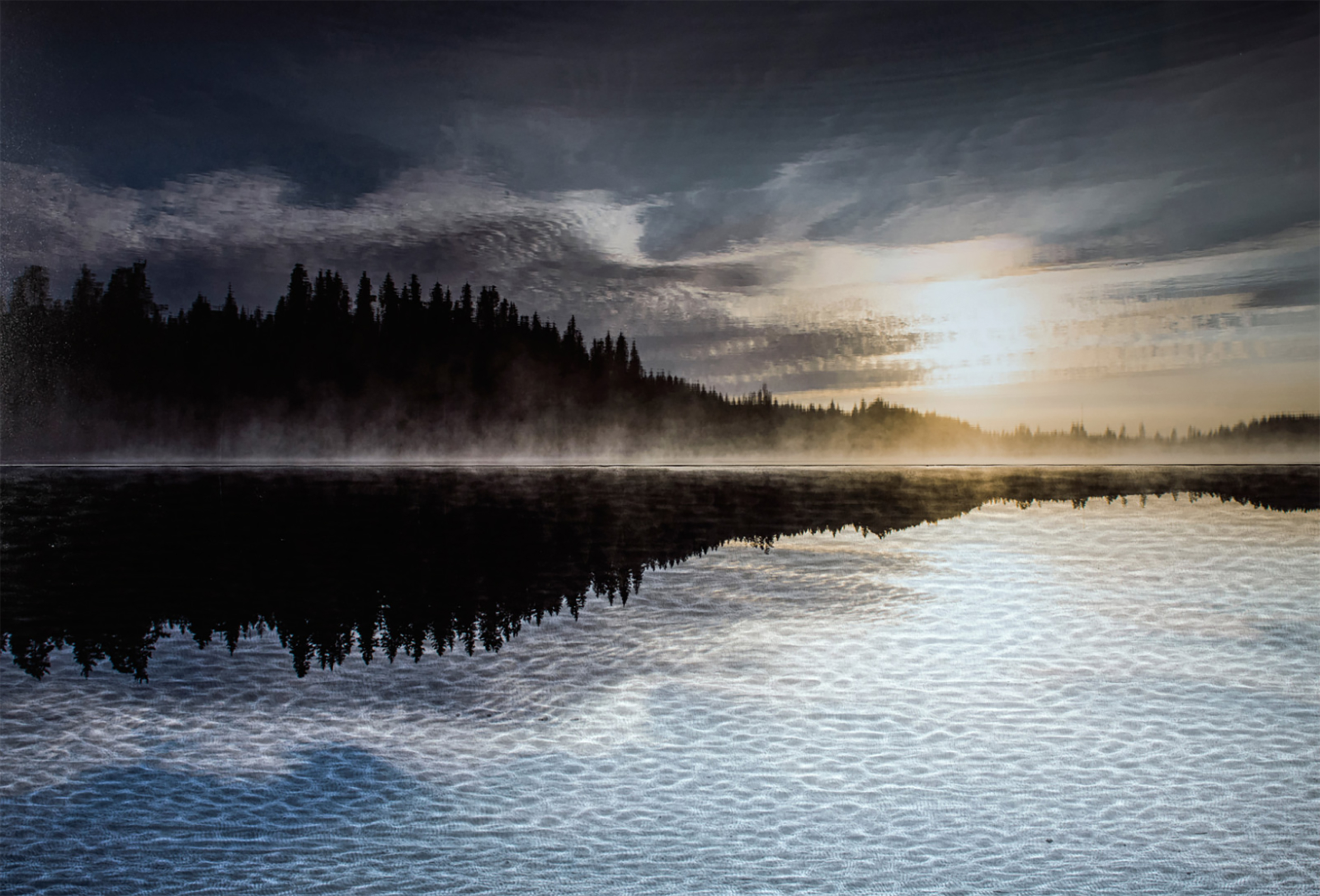
A lake. A luminous mist rises from the water’s surface. Behind it, the forest; above, the sun veiled by clouds. Yet appearances are deceptive. The surface of the water is not the surface itself, but rather its own reflection, thus misleading the eye.
The mist glows with a dazzling brilliance, only to sink immediately into a dull, gray darkness. As one approaches, contours emerge, the image comes to life, and a black outline reveals itself as though materializing from nowhere.
It is the reversal of circumstances. Where north becomes south—where the cardinal points are inverted—where water turns into sky, and above becomes below, where even light and shadow exchange places—it is precisely there that Miguel Rothschild’s pictorial spaces emerge. The conceptual spaces that accompany them, situated at the intersection of spirituality, faith, and myth, of religious exaltation and profane aesthetics, arise naturally. Rothschild’s fascination with ambivalence, his enthusiasm for the mystery of the nebulous as well as for the blinding power of white light, form the point of departure for these new works.
The exhibition The Splendor brings together works created over the past year that introduce new approaches within Rothschild’s oeuvre. For the large-scale works titled Nöck, the artist employs a highly reflective material as a support, which he then covers with charcoal drawings. Inspired by the water spirit of the same name—a creature from Nordic mythology that lures people into the depths by changing shape—the work undergoes profound transformations depending on the viewer’s perspective and the lighting conditions. Through the dialogue between the earthly, tactile blackness of charcoal and the reflected light that seems to emanate from within the image’s surface, Rothschild constructs a space whose impact is almost impossible to evade. Here, “splendor” does not simply signify radiant brilliance, but rather a force in constant transformation. Nöck is, ultimately, a memory of Romanticism: “Everything visible clings to the invisible” (Novalis).
The works titled Doppelgänger, by contrast, confront the viewer with a divided reality. Here, Rothschild disrupts the natural order of the landscape motif through a 180-degree rotation. Reflection, as the motif’s subject, does not merely duplicate the image. Through the use of different pieces of glass placed before the landscape—one of them inverted, mimicking a liquid surface—the artist creates an uncanny “other.” Splendor here becomes a form of illumination that disorients. It is an encounter with a mirrored world in which sunlight plunges into the depths of water. The physical clarity of the glass in the lower portion of the image materializes what is, in fact, immaterial. Beauty persuades by revealing that the world we know possesses a “sacred” reverse side—a spectral double that discloses itself only when we dare to look at the other side of things.
