

September 19 — December 13, 2026
Río de la Plata
In 1516, Juan Díaz de Solís reached these waters and named them Mar Dulce—the Sweet Sea. Ten years later, Sebastián Caboto’s expedition was given objects fashioned in silver by Indigenous peoples of the region. The metal had travelled there along ancient trade routes from the Andean highlands, far from these shores. This tangible discovery gave rise to a promise: that somewhere upriver lay an inexhaustible source of silver. The river was named after that promise. In time, the country that emerged along its shores took the same name: Argentina, the land of silver.
But the silver was never here. It was in Potosí, in another geography, outside this territory. The name was born out of absence: a desire directed toward a place that was not here. And the water that carries that name is not silver. It is opaque and brown, thick with sediment—among the murkiest waters in the world. Beneath the surface of a name that promises brilliance lies mud. The name and the thing it seemed to describe never coincided: Argentina is called the land of silver for a silver that was never its own.
This work begins with that founding distance, that disjunction between myth and matter, and considers a river that has been, from the outset, a site of projection: a screen onto which greed and extermination, the sacred and the spectral, the alluring and the terrifying have been superimposed.
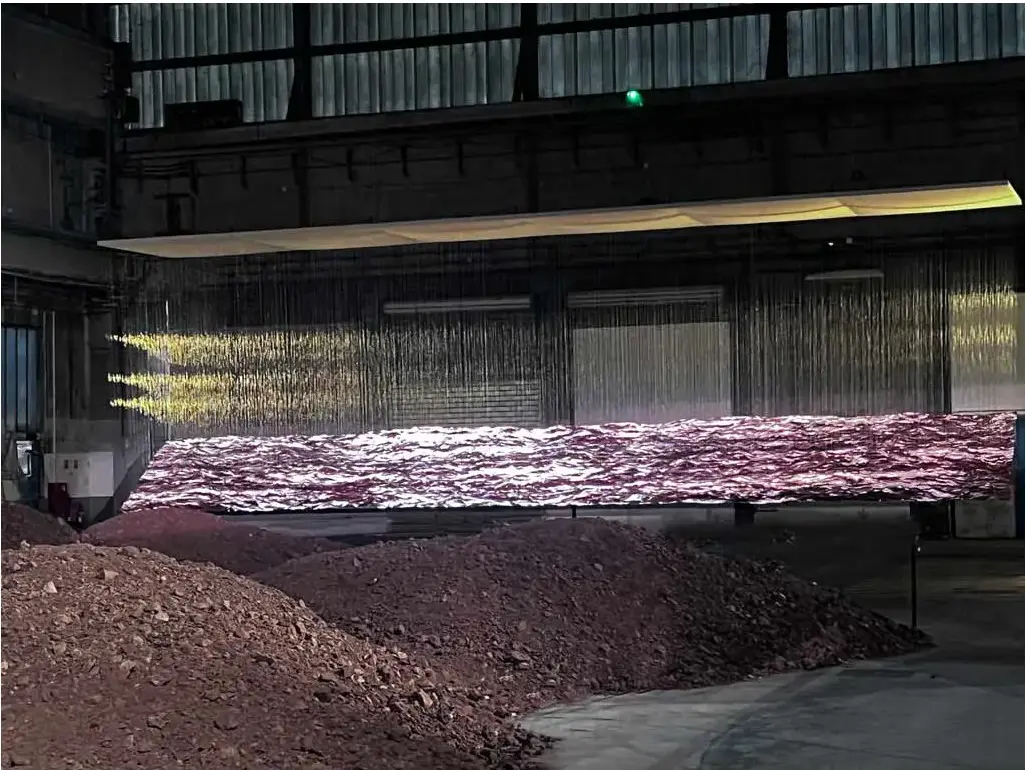
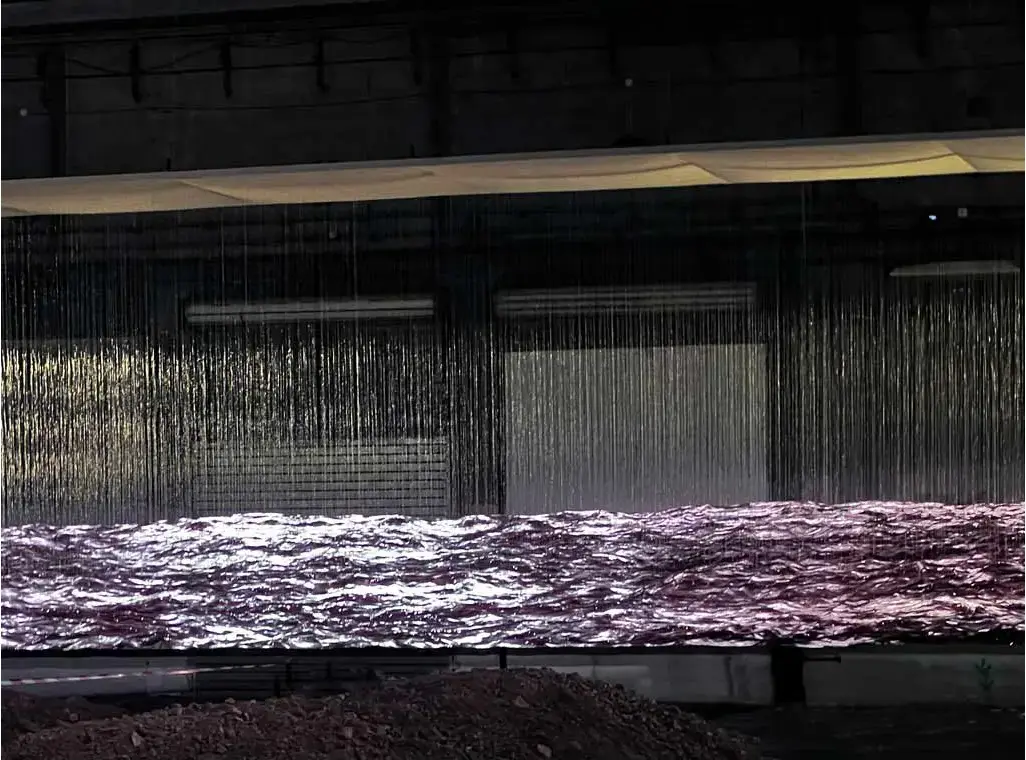
A suspended plane descends from above like a curtain of water or time. Threads fall and gather, gradually becoming matter, forming a rippling topography that moves between a reddish-brown tinged with blood and the silvery, leaden gray of water beneath an overcast sky. The surface evokes, at once, the silver mountains imagined by the conquistadors and the bed of the actual river: two images laid one over the other. For in the Río de la Plata, founding myth and historical wound have always occupied the same ground. Unsettling, beautiful, tragic—two sides of the same silver coin.
Beneath this suspended mass, a scattering of small sinkers breaks away and falls, drifting outward before dissolving into the shadow cast by the work onto the floor. That shadow—empty and dark, yet identical in shape to the sculpture suspended above it—is the other river, the one that does not shine: the river that holds what sinks.
Here, across centuries, the bodies of Indigenous peoples exterminated during the conquest and colonial period converge with those thrown alive from aircraft during Argentina’s last military dictatorship, in the so-called death flights. From the very beginning, the Río de la Plata was also a river of the dead.
The installation does not seek to illustrate this history. Instead, it allows it to reverberate through two superimposed, unresolved layers: what hangs and shines, and what falls and darkens; the promise contained in a name, and the absence that sustains it; the unrestrained desire for a city of silver, and the concrete horror of those sacrificed in its name.
Like the river itself—a turbid mirror that reveals only fragments of what it conceals—the work attempts to cast light into those depths: into the water and mud where the enchantment of the unattainable and the irreparable horror of violence and extermination remain, indistinguishably, intertwined.
